Sunday, February 6, 2011

Cultural differences, studying and a day off in he Theban Mountains

One day during the teabreak I fix myself a cuppa and somehow manage to bang my head against the bookshelf in the corner. It isn't too bad. When the lesson ends and I leave the classroom the lovely Eugenia sits at the manager's desk holding a cold waterbottle against her face, cooling her eye. It turns out, she banged her head against the same bookshelf. While I only have a small lump on my forehead for a few days, Eugenia's eye turns dark purple and blank. We walk to the cash point together and the moment we leave school, a young Egyptian man materializes and starts: 'Hello. How arrrrrre you. What happened to your face?' 'I hit somebody who hussled me in the street', Eugenia answers, but sadly he doesn't believe us.
A few days later I lose my temper and raise my voice, telling a man in the street not to call me Sweety or Honey, that I am not his darling. He thinks I need to relax. I explain to him that he is being rude, but I leave it there, because they just don't get it and I'm just wasting my time.
The food at Affaf's is as good as it was at her sister's. The one thing I don't understand is that in the bathroom, there is neither any loo paper nor a suspicious looking tube. Yet I hear the family use the bathroom. I decide not to ponder too long on this. Since I have paid a lot of money to stay with a family I think they should provide loo paper, but I'm tired of asking for things. So I nick a role of loo paper from the school. I have my own loo paper now, and I'm not going to share it. The family can … do whatever they do in the bathroom.
Affaf has two very lovely daughters. The older one, Abla, speaks English very well. The younger one, Abia doesn't, but we still get by with smiles and single english and arabic words. She also wears a pyjama all day, and Affaf puts a nightgown on, when she gets in, even if she has to go out again a few hours later. Abia doesn't even get changed when she goes out to get some bread. Now I notice that all the little girls in the streets run around in their pyjamas all day. I ask Affaf, why they bother with long hair at all if they wrap themselves up all day. She explains to me that the women want to be beautiful for their husbands. „The most important person to like your hair is your husband“, she says. I disagree. I think the most important person to like her hair is she herself. But I realise I have given up on exchanging opinions.


Affaf and Abia

Sallam asks me, at what age women in Germany get pregnant, and why they don't have babies immediately after their wedding. I tell him women want to work. He doesn't understand that. He tells me so.'Why?', he asks. 'Because they enjoy it', I answer, 'they can chose what they want to work, who they want to marry, when they want to marry and when they want to have babies. They have choices.' He is convinced that women in Germany don't want to get married and don't want a family. 'That's not what I said', I answer, 'they do. Only they want other things as well. They want more.' 'That is very bad', Sallam says, 'I hope women here never think like that'. Of course you do, I think, but like so many times I stay silent. I wonder if he considers me a potential hazard now, who could wonder off and start putting dangerous ideas into their women's minds any time. I allow myself an evil smile by myself, but I know that I wouldn't achieve anything, even if I did want to put ideas into women's minds here. They think along the same lines like the men.

Many times I get annoyed. In this blog I don't write about the attitude of the Egyptian men and about how rude they are towards European women anymore, about the many run-ins I have with Sallam or about how it upsets me how Europeans are systematically being being ripped off, because I fear that this would turn into a very negative blog. My Arabic lessons become more and more demanding. I feel like a vessel that Sallam piles loads and loads of stuff into and even though I feel I'm full to the brim and can't take on any more, he still keeps pushing in more. I spend the afternoons with the Italian girls studying. We take the ferry to the westbank to sit in a garden café or we sit on the roof. It is very noisy up there and the smell of the Shisha that everybody around us seems to be smoking is not great. But the food and drinks are lovely and the view is so worth it, especially when the sunset paints the sky above the Theban Mountains pink. I love those mountains. The next Friday I take the Italian students onto a walk along the Western Mountains to help them make a connection to the land. We take the path up from Deir el-Medina and then along the ridge above the the tombs of the Nobles, take a peep into the Valley of the Kings and then come down around Hatshepsut's temple in Deir el-Bahari. It's good to spend a day in the sun, feeling the warmth and the dust on my skin and link in with Hatshepsut. I feel a strange connection to Hatshepsut, in a sort of female line/ancestorial way, and always have. I love her for her strength and her uniqueness, for her divineness, the daughter of Amun, who ruled as Pharao, and for her humanity, the woman who loved her country and her consort, Senmut. I love her temple and am very touched everytime I pass it.
I draw the attention of my friends to the beauty of the Theban Mountains, to all the tombs and to the fossilized shells from such a very long time ago, back when desert was an ocean. The immensity of the planet we live on, of life and of time makes me feel very much alive and connected to the whole world.


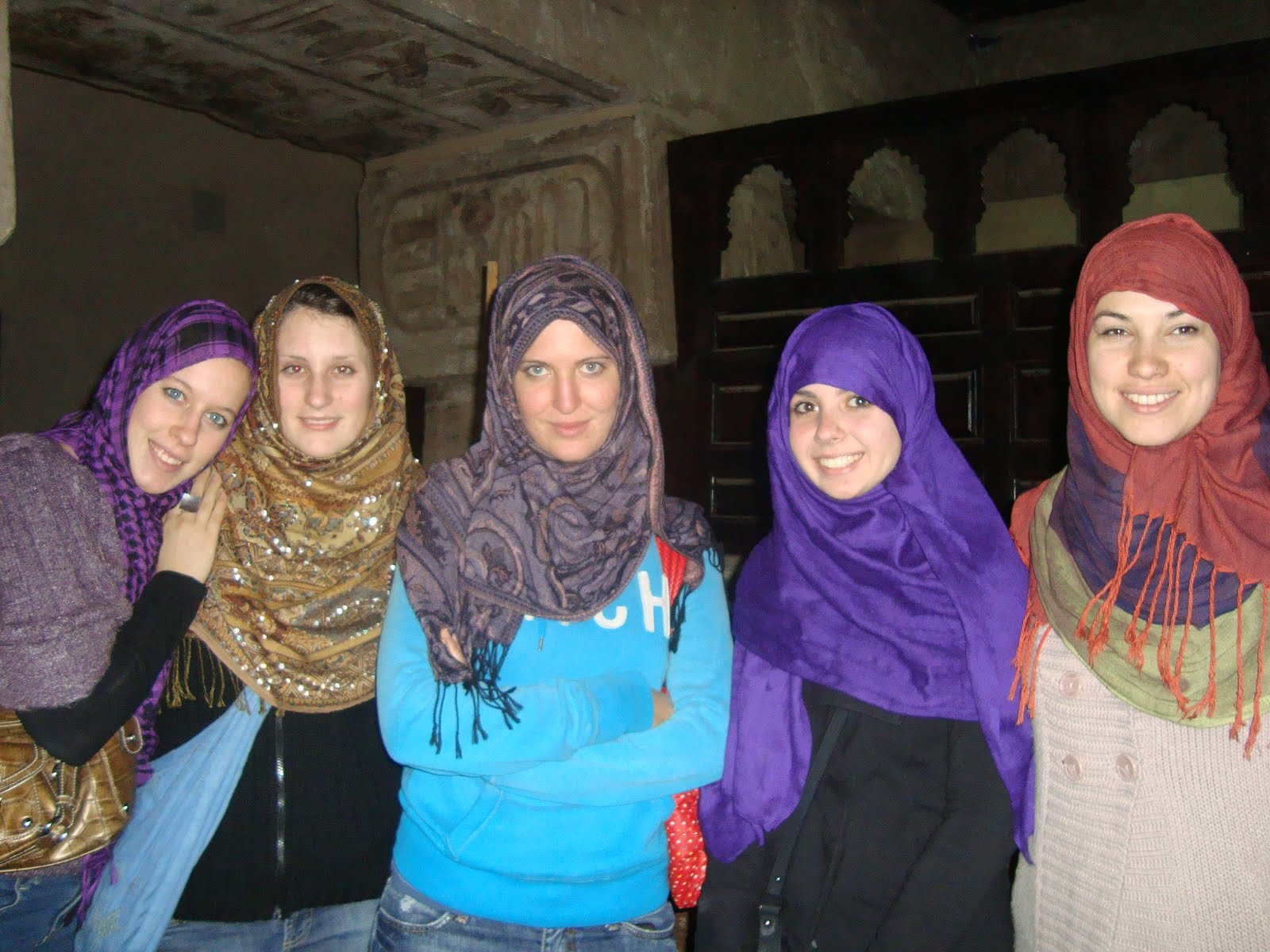
Paolo, Eugenia, I and Elisabeta
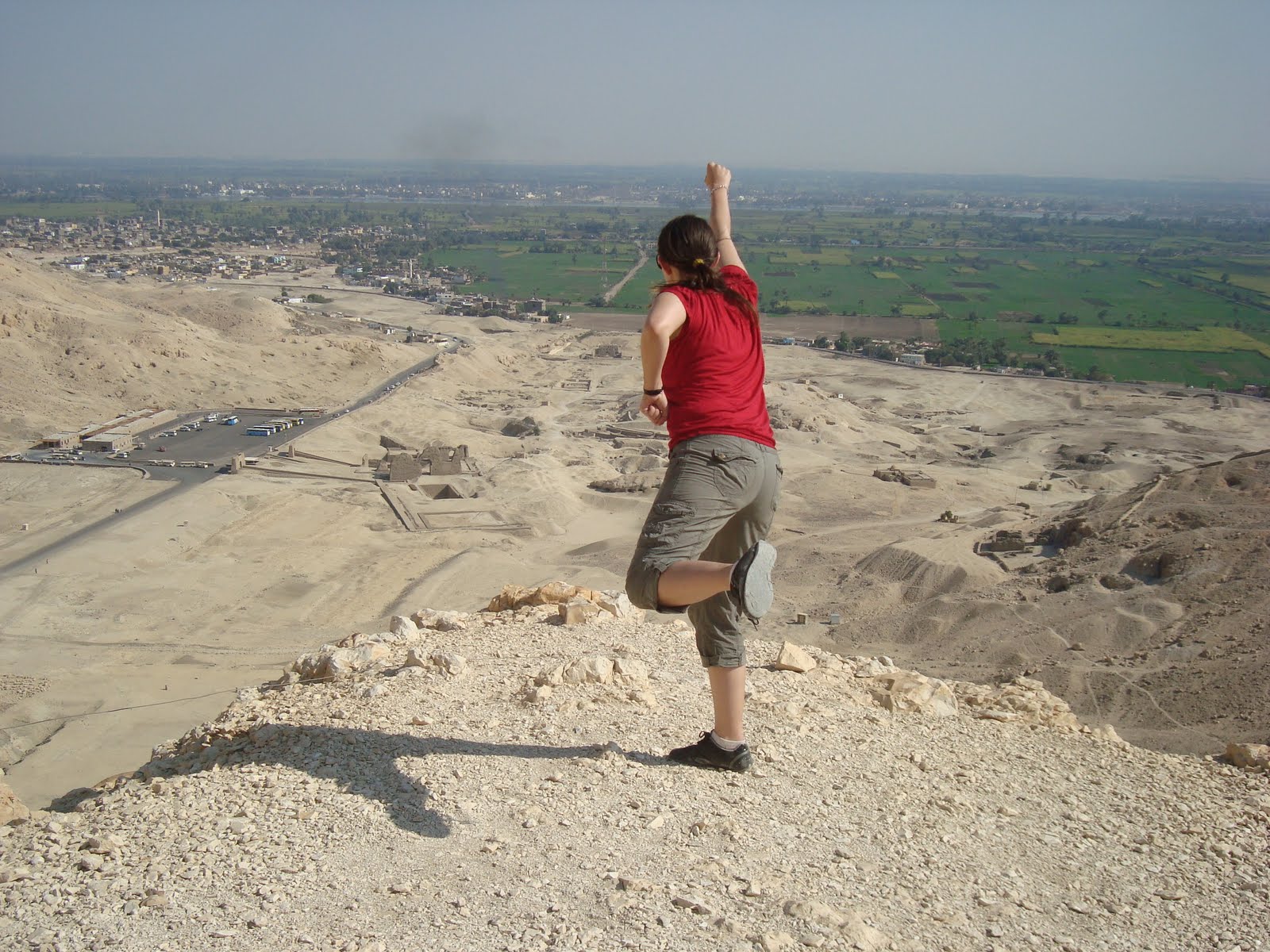


I at Deir el-Bahari, Hatshepsut's temple at the back


Moni and I at the restaurant after our landscape walk

Wednesday, January 26, 2011

Rain

One afternoon as I walk to school I feel something wet hit my face. I think I might be walking underneath somebody's balcony where they've put their washing out, but as I look up and check there is no balcony above me. All over town I ocasionally feel wet driplets on my face. There s nothing to be seen on the ground and I think, aha, so this is what you'd call rain in Egypt. In Germany I wouldn't even have noticed, but here it stands out, I think.
About one hour later I step onto the school's balcony. It is actually heavily raining! There are puddles in the street and I watch one clever Egyptian take the opportunity and wash his motorbike.
When I walk home after my belly dance class, the rain has stopped. It is quite cold and the streets are unusually empty. The town has changed. I see a few men still sitting outside cofee shops smoking their Shishas, but the usual crowd of people who just hangs out in the streets is gone, and so are the sweets sellers, the caleches, the taxis and the beggars. I take my time walking home, thoroughly enjoying being able to stroll down the streets without being hussled. The temple is still illuminated and I suspect that in the rain they might not have bothered switching the lights off which they usually do around nine. Maybe the rain has confused them so much that they forgot what they normally would have done. I can't believe my luck and take some spectacular shots of the pylon reflected in the puddle. At least I think they're spectacular. The stupid idea of this coffee table book is stuck in my head and I curse myself for it, because that's always how it starts... you have one good idea and then you end up organising a Conference... I shouldn't have thought that... now I'm thinking, surely putting together a coffee table book about Luxor temple must be a lot easier than that was?


Luxor Temple after the rain

After one week I move house. I don't want to leave, because I like Mona, Sayid and Zahwa, and at the same time I'm glad to go. At Affaf's, which is where I am staying now, there is a proper bathroom and I have my own bedroom. Sallam gives me a lot of homework everyday and it was too hard to keep up with things at Mona's. I couldn't study properly there, sharing a room where people kept going and out. Also because the family never went to bed before three o'clock in the mornings I also didn't sleep very well. It is very quiet at Affaf's. I spend the whole day on my homework and I don't know if this is because I am so tired or if I am so tired because I am studying all day. The first two nights I go to bed at 9:30 and sleep until 7:30. I'm amazed that I do manage to memorize all these words (or 'mommerize' as Sallam pronounces it) They either all sound the same and only differ in one letter, or they are so foreign to me that they are some meaningless syllables strung together and I go to lengths to find a suitable memory hook to remember them. But somehow my brain manages. I marvel at how my brain works, as if it wasn't part of me but something working on it's own accord, I have no idea how it does it, but I am thrilled that it does.


The Valley of the Queens

On Friday I rent a bike and cycle to the Valley of the Queens. It is a lovely warm sunny day and I am glad to be on my own. There are three tombs to be visited, two princes' and one queen's tomb, all 19th and 20th dynasty. The valley seems deserted, there are practically no visitors there and I take my time looking at the decorations. I am most interested in the depictions of the gods and goddesses. I see Sobek, Bastet, Thot, Osiris, Isis, Maat... and I have them all to myself. I am also getting really good at secretely taking photos. It's not allowed to take photos, but my conservator friend explained to me that there is no reason for this. The flash doesn't actually damage the decorations at all. I can't help myself though but think that the depictions of the goddesses are not as aesthetical and perfect as the ones of the 18th dynasty anymore. The proportions already start to look less graceful. I think that might be the heritage of the Armana style, when Akhenaton started to depict himself and his family a lot more natural then the pharaohs before him did. Or maybe this isn't my own clever conclusion, maybe I read that somewhere I can't remember. Anyway I think that the art of the ancient Egyptians had its peak in the 18th dynasty. Just look at the tombs of Ramose and Sennefer and at Hatshepsut's mortuary temple!


Thursday, January 20, 2011

Abu El-Haggag Mosque

One evening Affaf takes us to visit the Abu El-Haggag mosque. It is the oldest mosque in Luxor, and it sits right on top of the Amun temple. It was built when the ruins of the temple were covered by Nile mud. There is a catholic church close to the temple, run by Italian franciscan monks. When Eugenia, Paolo and I visited it, the monk told us that the first franciscan church was also built on the temple ruins, without them knowing that there was a great temple of Amun Re beneath it. When the temple was excavated the catholic church was moved to where it is now. The mosque was allowed to stay. Since I frankly just cannot be interested in everything in the world, I never bothered finding out much about Abu El-Haggag, but I do know that he is some sort of patron of Luxor. So the mosque is still there. The coptic church however will probably have to move anytime soon.


The altar of the Franciscan church


The altar of the Coptic church Santa Maria


Weird looking nativity set and dirty bikes in some corner in front of the Coptic church


The out side of the Coptic church

It is situated behind the temple above the sphynged alley. The great temple complex of Karnak is about three kilometres from the Amun temple in Luxor. In pharaonic times the two temples were connected by an avenue of sphynxes. A few of them have been restored and set up before the temples, with human heads in luxor and rams in Karnak. The rest of them lie under the town: In the course of millenia Nile mud, sand, dust and litter have accumulated above them and thus formed what is the ground level of modern day Luxor. One or two years ago however it was decided that the Sphynx alley was to be excarvated to make Luxor more attractive to tourists. So far I haven't met anybody who was happy about it. After all, there is a town above it and in the course of the excarvations, everything that's built on the course of the Avenue ist simply being torn down, including houses, mosques and churches. And my archaeologist friends told me the excarvations aren't even conducted properly, but without the necessary documentations. Aparently, since they know where the avenue is, they simply clear away all that's above it and litterally dig the sphynxes up. And since the coptic church is on that course, it seems likely that it will have to go, too. I don't know who's in charge of this excarvation, but since they have the power to remove buildings, I guess it's the egyptian government. The lady giving us the tour was very upset about it. She kept saying „This building is 102 years old!“ I couldn't help thinking, „Well, that's 102 years against 4000... not a chance.“


The Sphynged Avenue leading up to the Amun Temple

When we come to the mosque, we have to cover our hair, so Affaf helps us wind our scarfs around our faces like the Arabian women. We all giggle and take photos. Later Affaf and her sister Mahida, who also teaches at the school, tell us how beautiful we look and again I smile, wondering by myself whether they think something along the lines of „Finally they are dressed decently“. Outside the mosque in a corner there is a group of maybe 30 men, singing. One of them is singing words on a tune, while the others rhythmically sing the name „Allah“ and clap their hands. Their eyes are closed and they sway from side to side. It sounds lovely and the men look blissed out. I wonder whether we could somehow work with that in the Goddess movement and start thinking about a song, which we could use for a sort of trancey experience like that. Meditiation through song, rhythm, movement... it works for me, to feel the divine in my body. I love it actually. We stay quite a while, sitting in a circle on the floor, watching them.
When Affaf takes us into the mosque we see the tomb of Abu El-Haggag. I am more interested in the bits of temple masonary that have been built into the mosque. I walk around and I see that the mosque actually sits on a much higher level than the temple, and I remember that Affaf told us it was built when the temple was hidden under Nile mud. In the men's prayer hall a fries of pharaos runs along the length of the wall, the women's prayer hall is built into the first court of papyrus pillars. I can actually touch the chapters and I love it. I love how the architecture of the new and the old blend into each other. I love seeing the cartouches of the pharaoh's names in this islamic house of prayer. I don't see many reliefs that have been chiselled out, and I wonder whether, if I could read hieroglyphs, I could find the name of Amun somewhere in the mosque. Or Isis even?
I like the mosque a lot. All the pharaoh's added to the temple in praise of Amun and at the same time securing their own immortality. To me the mosque is just like that. Amun and Allah are but different names for the one Source and Abu Al- Haggag added to the temple complex, ensuring his own memento in the process, just like Amenophis III, Hatschepsut, Tuthmosis III and all the others.
I'm having an utterly lovely time in the mosque. I take some photos of the pillars and the giant statues, only now my perspective standing by the mosque is that I'm looking down to them. It's fantastic. More photos of Luxor temple for my coffee book table.
When we leave the mosque the girls and I start a little experiment. We keep the scarfs on as we walk back to the school to see if we're still being hussled as much. There is singing and drumming in front of a photo studio and Affaf explains to us that it's a wedding, and the couple is having their picture taken inside. We stop and watch a little and suddenly four young girls come up to us, smiling. They want to talk to us, which has never happened before, the girls have never approached us before. They want to know our names and whether we're muslimas. I'm fascinated of how easy it is to set up a barrier between women, but also how easy it is to build a bridge. When we tell them that we're not they seem a bit disappointed, but still interested. They don't speak english though and my arabic is not yet fit for a conservation. So I give them a smile and wave at a taxi. I go home.


Monika, Elisabetta, Sophia, Alice and I


Top of one pillar of the temple integrated into the architecture of the mosque


View from the mosque down into the temple court

Tuesday, January 18, 2011

The Amun Temple of Luxor

When I excavated in Egypt the exotic language was one of several things that made the whole time a magical one. Now that I am among linguists there is nothing but the language and after one week I admit to myself how bored I am. I don't get round to doing much but studying and I crave visiting a temple or even better a tomb and lose myself in the decorations. Also I have very little time to myself. In school, in the flat or in the cafés where I study there are constantly people around me. I promise myself a trip to the Westbank all by myself soon. The only monument on the East bank is the Amun Temple. I have probably walked around it one hundred times now and photographed every pillar of it. My favourite time with the temple is nighttime. It is beautifully illuminated in the dark. I am drawn to it again and again and my eyes wander up and down the mighty yet graceful pillars. The painted decorations on the lotos and papyrus chapters are long gone but the mere shapes are harmonic and beautiful. So is the pylon, the obelisk and sphynged avenue. The spectacular egyptian sunsets adds to the magic and last summer they have begun illuminating the western mountains at nighttime as well.


View from my roof top table over the temple as sunlight begins to fade and the night takes over


A bit later the same day: Luxor temple and the Theban mountains


Sunset fire sky above the Nile

I have taken so many photos of the temple that I could produce a coffee-table book. I sit on the rooftop and gaze over to the temple, the pink and orange sky and the illuminated mountains and contemplate how visual stimuli influence how I feel. The way the light is used as a tool to add to the beauty of the natural landscape and of the monument the ancient egyptians have created... I feel happy, at peace and connected to the people long past. And then the waiter turns the television on and all the magic is blasted away by the noise of advertisements and of piercing arabic popmusic. I pack up and flee.

Friday, January 14, 2011

Luxor impressions

It is a weird stay. I am not a lover of today's Egypt. When I lived in the necropolis everyday was magical, the pharaohs alive and the ancient gods and goddesses among us. Now that I live on the East bank every day is noisy, busy and exhausting. The egyptian men are doing my head in. I can't walk anywhere without being shouted at. They want to offer a taxi ride or a caleche (a horse-carriage) but they don't speak english, so they just belch words: „Caleche!“ „Taxi, taxi!“ For some reason they leave the i the second time, so what they actually shout is „taxi, tax!“ I don't know who put that into their heads. Young men who don't seem to want to sell anything still jump at me to talk to me: „Hello! Rrrrrememberrr me?“ is a popular line to start, or „Nice to see you again“, even if I've never seen them before in my entire life. Another one is: „How arrrre you?“ Or: „“Where zit frrrrrom?“ I try to ignore them or just say „Shukran“, Thankyou, when I'm not sure if they do want to sell something or not. The next thing is that they want to know my name and if you make the mistake of answering they'll never leave you alone again. When I worked on the West bank we always ran like crazy through Luxor, when we had to get somewhere, never looked anybody in the eye and never answered. They also creep up from the side and whisper in your ear without any preamble: „Lovely“, „Yourrrrr a beautiful girrrl“ or „Nice ass“. It is fairly disgusting, it is the way they say it, and I'm sure they would never say that to egyptian women. I don't know if they're aware of how offensive they are. I just walk on, despising them. Sometimes they call after me: „You lost something!“ The first two times I fell for it. I turned around, and of course I hadn't lost anything. „Hello, how arrre you.“ Here we go again. I walk away. „Welcome to Alaska“, is another favourite line. I say this bluntly, but this is the way it is. Their behaviour makes me never want to go to Egypt again. I will come back though, of course, to visit the monuments, visit my archaeologist friends, renew my connection with Isis and do ceremony, but I'll never stay on the East bank again, and I'll keep away from people as much as possible. I'm sorry, but I didn't come here with this attitude, I react to what I experience here. I can't understand the many Europeans who get stranded here. I see them sitting in jewellery shops or other tourist-y shops in or near the souk, drinking tea and smoking. It would do my head in.

Christmas decorations on the Corniche? For lack of fir trees: fairy lights in a Bougainvillea tree.


Caleches on the Corniche

The women are not as bad. Most of them ignore me, if I have to ask for directions I always ask young women with babies, the are the nicest. Mostly they are very friendly give me the information I need and a smile and there is no problem whatsoever. But some of them want baksheesh and their opening line is „Sister, sister!“ When I hear that I start running. There's lots of dirty children in the streets who are trained to beg. I don't mind them as much as the grown ups, even though they are very persistant, grabbing my arm and continuing to beg, even though I tell them in arabic to stop it and that there will be no baksheesh. I give them pens though. I have tons of TUI pens left from when I worked for them and I brought them especially. I like to think that they go to school and use my pens there, that they get educated and that their children won't have to hussle Europeans in the streets.
Apart from the young men, the noise in Egypt is driving me crazy. Cars honking, motorbike engines, donkeys shouting, horse shoes on the tarmac, people shouting all the time. Men cycling through the streets trying to sell something and shouting out what they've got. The muezzin. The television which is constantly on. The televisions in all the coffeeshops and restaurants. Streets being torn open with jack hammers (and then left like that...?) things being fixed with loud clanking hammering noises, in the middle of a coffeeshop terrace in the middle of the afternoon in the middle of the customers. I marvel if the egyptian soul gets stressed when it gets too quiet. They take out their mobile phones in a restaurant while eating and chatting, put them on the table and have them play some music, which of course, coming from a mobile phone, sounds crap.

Here Germans have a reputation of being snobbish. But I am looking forward to walking down the streets without having to talk to a million people, but being able to chose who I want to talk to. I look forward to walking into a shop and deciding what I want and if I want to pay the stated price or not without being hussled. I look forward to people not trying to ripp me off all the time. Maybe I'm a snob.

Having said all that I should probably point out that at the same time I do like Luxor. I like the colours. I like watching the women, dressed in their layers, scarfs around their heads. I would LOVE to photograph them but I think it's something that's frowned upon. I like the vegetables, the spices, the blue of the Nile and the flowers in summer. I do like the way the neon lights are over the top. I used to even like the Souk, but I don't anymore. The hussle there is too much. I like crossing the Nile on the ferry and most of the time I like the muezzins. I absolutely love the taxis. There are different sorts of taxis, I always take the ones they call "microbusses" here. They are vans which go around in circle lines. There are places all around Luxor where they regularly stop, but you can go on and off anywhere else as well. Inside again I enjoy how over the top the decorations are: animal-faced hoods on the seats, colourful pictures on the ceiling, allovers and tussles. So I wait by the side of te street, put out my hand and wave at the taxi. Every trip on the East bank costs 50 piastres, sometimes the drivers want to rip me off, but I know the prize and it's a question of honour to make sure I get my change. It doesn't matter if 50 piastres are only 7 cents. You just hop on the taxi and then you get your money out. If you sit behind the driver you just hand it to him. If you sit further back you tip the person in front of you on the shoulder and they pass it on all the way to the driver along with the info of how many people you're paying for and then your change comes back the same way. For some reason this amuses me a lot, when the money hops from hand to hand upt to the driver. It reminds me of a game we played as children, where a fingerring was passed from one hand to the other and you had to guess in whose hand it was. I think there was a song with it, but I can't remember.


Microbus (what I call a taxi)on Television Street (that's not one of my names, it is really called that)


Inside one of the taxis

And there are even times when I like the noise in the streets, like above mentioned, sometimes I like the Muezzins. There are several mosques over Luxor, and when all the Muezzins chant it sometimes sounds really harmonious. Also I am always amused, when somebody calls at the house. Because the y literally do. There is no doorbell, and the door of the house is open. People just come in and then they knock on the door to the flat. If they don't want to come in bust just want to know something they just stand in front of the house and shout up to the balcony, they really do. And then Hamada puts his head out the window and sees what they want. Sometimes he puts his head out the window and shouts up to Bussi who lives above us. And sometimes Zahwa even put her head out of our window and shouted for Ahmed who was in the room next door, who then put his head out of that window and then they talked sort of around house because it was quicker than leaving the room and popping over to the next one.


Spices


Colours of Luxor: decoration in the streets


Colours of Luxor: street market in the Christian Quarter


Street in Luxor with the balconies, where people like to stand underneath and shout for the inhabitants.

Thursday, January 13, 2011

Arabic lessons begin

Zahwa believes that Ahmed is able to fix the computer anytime. She says he can do magic. In truth I have seen him successfully set it back up only one time. The internet in the flat doesn't work anymore, and Ahmed just pulls the cable and puts it back in. The next evening it is back. Wether this is due to his magic or whether this is just how it is in Egypt, I do not know.
The older of the two little girls who sang for me on the first evening comes back. Her name is Bussi. I'm sure it's spelled differently, but it just cracks me up. Bussi! How funny is that. She turns out to be magical Ahmed's godchild, and she loves him to bits. It's funny to watch. He seems to be a horrible big bossy brother to Zahwa, but he's sweet with Bussi. Bussi plays games with us, tells me stories and I don't know what and doesn't mind that I don't have a clue what she's on about. I seem to make perfect sense in her world. At the end of my first week Ahmed leaves the flat and goes back to Uni. I wonder if Bussi will still visit us.


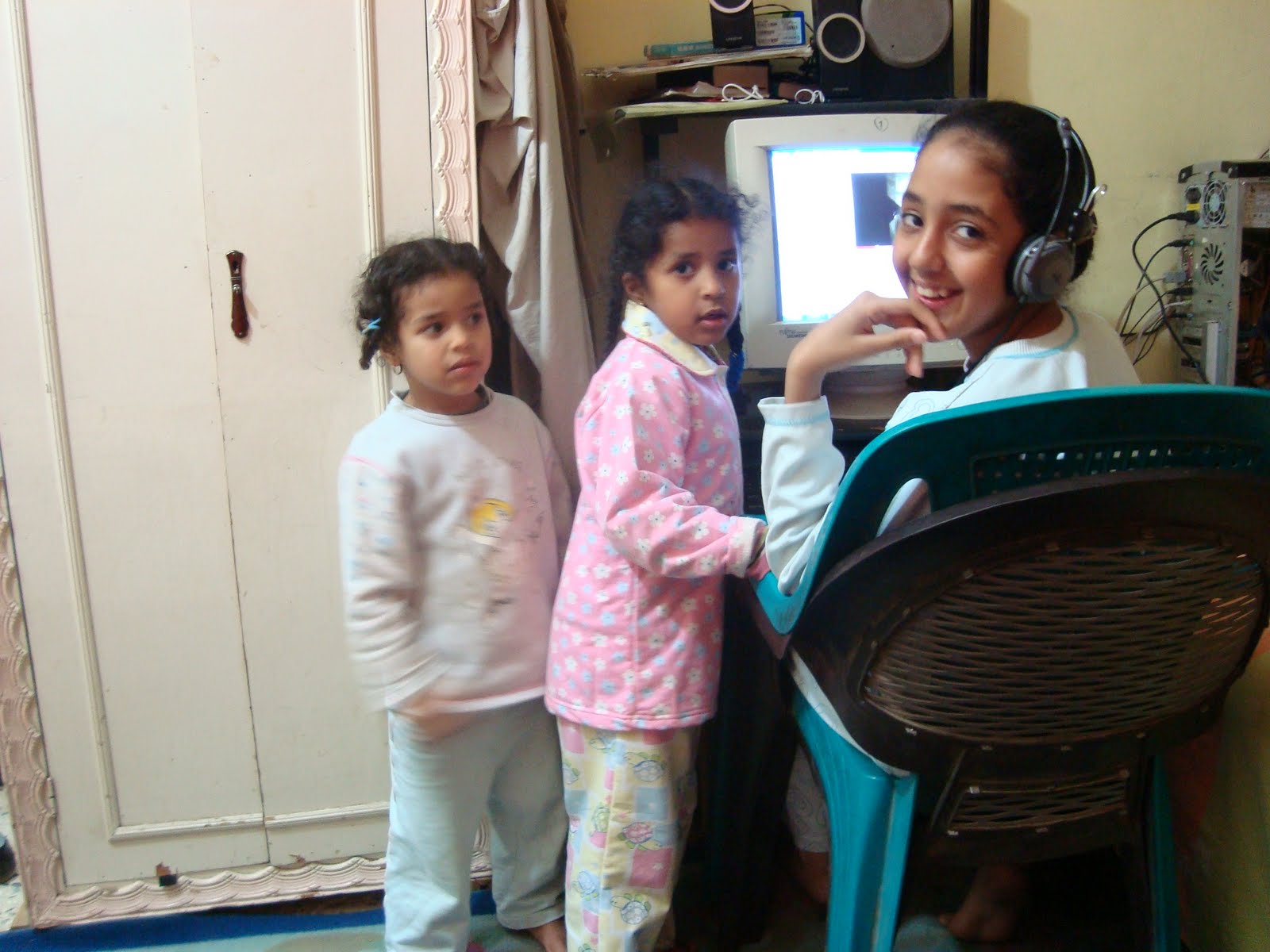
Zahwa, Bussi and tiny girl


I have spoken to Affaf about the bathroom in the flat and she has promised to speak to her sister. I'm curious if something is going to be done about the bathroom, but I don't really think so. After the first week I still find the bathroom disgusting, but it doesn't upset me anymore. I think that I must have some really strong survivor-gens in me, who would have thought? I'm very pleased with this discovery.
As I finish the paragraph about the bathroom Bussi pops in, dances around the sitting room, sings me another song, plays her favourit game and disappears again. She's a tiny avalanche.
My arabic lessons start. My teacher, Sallam, is very pleased with me. I find it all a bit much: the letters, the sounds, the words. I knew a few of the letters before, so we got through the alphabet within one hour. He says that usually takes one week and now he thinks that I'm super intelligent, that I can remember immediately every word I have seen written once, can spell and write it from memory and also remember everything he tells me once about grammar. I want to learn as much as I can within these three weeks, so I am very ambitious and I study a lot and make every effort. To my surprise I understand and really remember the grammar bits and I do my best to memorize the words. Sallam likes to wind me up, when I can't remember a word or spell it wrong he pretends to be angry and disappointed. Then he tells me that I needed a third of the regular time to get to the point where I am now and that he thinks I'm an excellent student. I'm quite proud of myself but it also makes me laugh, because this has only just begun. I usually am good with things in the beginning, and then I get bored and I tend to leave at that point. This is the reason I have tried out many things but rarely really mastered something. I hope that three weeks are too short a time to get bored.
Sallam's english is interesting. Most of the time there's no problem. Sometimes however he teaches me words which don't exist, like apricok and I smile to myself when I finally find out that he talks about apricots, or he pronounces them so bizzarely that for two days I think one word means butter when it means bottle. It doesn't happen very often though. He is a bit of a macho. When he found out that I'm thirty and not twenty-four as he thought, and that that makes him only three years older than I, he got a little upset. It was the fact that his hair is turning grey and mine isn't, I think. I think he's a bit vain. What annoys me is that very often he doesn't understand my questions. The same happened in Uni many, oh MANY times, because I think too much, expect tings to be more difficult then they are, and teachers don't understand what my problem is. But this is annoying when met with his self-righteous/egyptian/maskuline macho bearing. Somebody else would not be bothered by this, but I am sensitive to these things. So I try to stay calm and not hold it against him, he's not the first teacher who knows no other way of reacting when he feels he's not in control anymore, because he doesn't understand his student. The thing is, this is an italian agency and his Italian is very good, according to the italian girls. So far I have managed to find out all I wanted to know and find the answers to my questions myself, which again makes me quite proud. And most of the time I get on well with Sallam. Anyway, in class I am doing alright with my arabic, but I don't see any progress in my spoken arabic at all. The family doesn't really speak much arabic with me, they get Zahwa to speak english with me. I decide that I will continue speaking in my broken arabic even if I'm tempted to just speak english and speed things up.


The Italian girls, Sallam, Hamada and English Jo on English Jo's last evening when we went for pizza.

Monday, January 10, 2011

First impressions

I spend the next few days getting to know my way around. I meet the other students, Sophia, Alice Elisabetha and Monica from Italy and Joanne from England. I am the only beginner. Since Joanne is not a common name in Germany it's the first time I meet another Joanne, and it amuses me big time. She takes me to meet a friend of her, another Hamada, on the westbank, and we spend the day in the garden drinking coffee.


English Jo and Westbank Hamada

As it gets dark, Zahwa rings me, but I can't work out what she wants from me. When I get home around nine I find out that she was worried about me, thinking I had got lost and couldn't find my way home anymore. She has also taken to buying me sweets. When she comes back from her evening classes she always has a chocolate bar for me. I do get lost in Luxor, but that is no serious problem. There aren't really many streets, and only a few major streets. The family lives in one of those minor streets that don't even have a name, off a parallel street of Television Street. I could just take the taxi to school and back every day, but I find it more interesting to walk and explore the streets. Since they all look exatcly the same I give the streets names, to help myself orientate myself. In one street I spot that they keep chickens on the roof of a five storey house, so that Street is Chicken Street. The egyptian men are very much in my face, but I don't think they realise that they're annoying. I think they sincerely believe what they do is regular western behaviour. They're not dangerous, I just walk on and the worst that happens is that I'm late for tea. The dirt in the streets is incredible. At one point when I explored the Christian Quarters I caught myself standing in a dead rat. Since I have all the necessary vaccinations I don't worry about myself in all that dirt, but the amount of litter does make me feel very uncomfortable.


The two Jos


View vom the roof top restaurant

The staff of the school and the other students show me some places to go out. English Jo takes me to a beautiful roof café with a stunning view over the temple, the Nile and the westbank, and we all go for a meal in another really beautiful restaurant. I took my mum to Luxor last November and in my mind I already collect places to go and eat or to shop or to show her when I take her to Egypt again.
In the family and in the school they ignore my name. I'm used to people not knowing how to pronounce my name from the provincial town where I grew up and am well trained to answering to literally anything. Here Mona calls me Julia or Joli, Johann, Jehann or Jeehann. Sayid calls me Jeejee. In the school it gets confusing as English Jo and I are both Johann. The internet in the school comes and goes, in the flat the computer dies and sometimes the electricity goes completely. When I open the window the whole quarter is dark, that is really dark. That doesn't stop the drivers from driving through the streets with no lights on, but I'm safe and sound up here and can just see a stretch of the sky with Orion in it above. Usually electricity is back quickly enough. I nick the internet cable in the flat so I can at least chat with Mitja and my mum. Without the support from them I wouldn't have lasted the first days here.
I start to adjust to life in the family and to adjust the flat to me. I change my rock of a pillow for some really soft cushions and at last manage to sleep better. The noise in the streets at night is incredible. The family stays up until 2 or 3 in the morning everyday. They don't seem to need any sleep at all, because they get up at 6 in the morning. But then of course you don't need too much energy for cooking, washing, watching telly and smoking. Some nights when I wake up and go to the bathroom I cross the living room where Hamada is sleeping and I find out that he even sleeps with the telly on. The sound is off, but the pictures are still on. I wonder why he does that. Zahwa is the only one who sleeps for hours. When I get up and turn the light on she just crawls underneath her blanket, tiny thing that she is, and stays there. When I come back from my lessons between noon and one she still sleeps. One night I am trying to sleep while the family is watching telly in the other room. Then I hear Mona shout Zahwas name and I think that she knows that I'm trying to sleep here and that she could really try and be a little les noisy. Zahwa gets up to see what her mother wants and comes back with a cough syrup. Turns out Mona has heard me cough and wants to help. After that Zahwa makes me herb tea, anise, everyday. I still need to get out of the house for long periods every day. But I think that's normal, I just need some time to myself. Apart from that I seem to get used to this world.