Today I can feel life's energy stirring within. I am full of ideas. I want to paint Freya and also a painting of Mother Nolava is shaping up in the back of my head. I also want to facilitate a workshop on Isis and I want to plan and create right now. But I'm off to work, so it'll have to wait just a little longer. On the other hand I very often come up with some really good ideas during work, note them down and that is valuable progress also.
I am going to facilitate a Beltane Ceremony on Saturday evening though. On the actual eve of Beltane Mitja and I went camping, so we did a very beautiful ceremony together, calling in the Lover Goddess, honouring each other, sending love out into the world and sharing May Wine. The event on Saturday is open to everyone. We will be celebrating the Lover Goddess Freya, Loreley and Rhiannon. We'll be celebrating our own sensuality and sexuality, we'll be calling in the Lover Goddesses of the world, we'll find the Lover within, we'll walk the Labrynth and we'll give thanks for the Love in our lives. There'll be drumming and singing and jumping the fire!
We'll meet at the Bus Stop Casselsruhe at 5pm. Minimum donation is 12/15€. If you want to come please let me know here or on facebook (look for Freyas Feuer) so I can get an ideas of numbers. Blessings of the Lady of Beltane xxx
Wednesday, May 4, 2011

Wednesday, April 27, 2011
Growth and Manifestation
I'm in a funny place. I feel how change is happening very deep down inside the core of things, while on the outside not much seems to be happening. I'm between trust and impatience, excitement and a feeling of failure, and at the same time I feel deeply connected to the Lady. I know that everything is in the flow, I see my life being full of love and joy and laughter, creativity, frienship and connection. And I know some of the things I want but haven't achieved yet, will manifest in time, and many more wonderful things I am not even dreaming of will come as a lovely surprise.
I've spent the last few weeks writing on the German Wheel of the Goddess, researching many of HER beautiful faces and names, connecting deeper to the Goddess heritage of my homeland. While the trees were blossoming in all their spring glory I lay on the meadow, reading and typing away. Mitja and I left some offerings of coloured eggs for Ostara on the day of the Spring Equinox, calling in fertility, growth and love.

We made Holle's plaits and and read the dialogues of Inanna and Dumuzi to each other. On the morning of Easter I went to the brook to drink some water in the morning sun, always calling in growth, creativity, fertility and abundance. Life is peaceful and quiet.

I'm hoping hoping hoping to get a positive response from one of the publishing houses soon. I love to write and it would be a dream fulfilling if I could one day live off being a writer. This is what I want.
I've spent the last few weeks writing on the German Wheel of the Goddess, researching many of HER beautiful faces and names, connecting deeper to the Goddess heritage of my homeland. While the trees were blossoming in all their spring glory I lay on the meadow, reading and typing away. Mitja and I left some offerings of coloured eggs for Ostara on the day of the Spring Equinox, calling in fertility, growth and love.

We made Holle's plaits and and read the dialogues of Inanna and Dumuzi to each other. On the morning of Easter I went to the brook to drink some water in the morning sun, always calling in growth, creativity, fertility and abundance. Life is peaceful and quiet.

I'm hoping hoping hoping to get a positive response from one of the publishing houses soon. I love to write and it would be a dream fulfilling if I could one day live off being a writer. This is what I want.
Wednesday, March 16, 2011
The Healing Process
The time is moving so quickly! I have had a very interesting time of Quickening with Bridie and of walking my truth with Skadi. When I had my Saturn Return I wanted to leave behind fear that causes me to make choices which don't support me on my own path to Truth and Happiness, but choices which seem to keep me safe, mostly following other people's fears and expectations. Having called in healing and liberation and change everyday I have at the same time tried to hold on to the same false security which suffocates me and takes my energy and makes me waste my time, living in fear, trying to fulfil expectations which don't nurture me. The fear to end up on the street and in poverty is so strong in me that I have never dared to be brave to live my dreams. And because all those plans which I try to follow to lead to safety and security never work out for me, because they were made by other people and for other people. They are like garments that just don't fit me.
So I struggle and I fail.
Goddess has such a strong way to draw attention to the things which aren't right for us. She has been telling me for six weeks to stop following somebody else's plan, and that I don't need a plan, that I just need to start living my life!
After a car accident, a break-in into the car I borrowed to use while the other car is at the garage, since repairing it seems to take forever, and investing a hell of an amount of money which I don't have I have now decided to give this job up. I have never so clearly experienced being kept from doing something (working at the school). I did enjoy it, but I'd rather get out before something worse happens to me.
So the message is clear. I am to believe in myself and to use the gifts I have been given, to listen to my own heart and to spend my life doing the things I love, instead of doubting myself and trying to be a person that I am not.
A huge and scary thing. I hope one day this prospect stops feeling scary, but natural.
So I love writing, painting, singing and the Goddess. I will do these things from now on without feeling guilty because they won't support me. I will do them because I feel half dead when I don't do them.
By the Rhine I did a ceremony today to let these old fears go and to be reborn, into my new life, to be reborn to truly be the woman and priestess I can be.
I ask for your blessings, Great Goddess, be with me on this path and help me. I feel deep gratitude for my partner and family who accept and love me the way I am. Bless my new life Lady, and let me be free!
So I struggle and I fail.
Goddess has such a strong way to draw attention to the things which aren't right for us. She has been telling me for six weeks to stop following somebody else's plan, and that I don't need a plan, that I just need to start living my life!
After a car accident, a break-in into the car I borrowed to use while the other car is at the garage, since repairing it seems to take forever, and investing a hell of an amount of money which I don't have I have now decided to give this job up. I have never so clearly experienced being kept from doing something (working at the school). I did enjoy it, but I'd rather get out before something worse happens to me.
So the message is clear. I am to believe in myself and to use the gifts I have been given, to listen to my own heart and to spend my life doing the things I love, instead of doubting myself and trying to be a person that I am not.
A huge and scary thing. I hope one day this prospect stops feeling scary, but natural.
So I love writing, painting, singing and the Goddess. I will do these things from now on without feeling guilty because they won't support me. I will do them because I feel half dead when I don't do them.
By the Rhine I did a ceremony today to let these old fears go and to be reborn, into my new life, to be reborn to truly be the woman and priestess I can be.
I ask for your blessings, Great Goddess, be with me on this path and help me. I feel deep gratitude for my partner and family who accept and love me the way I am. Bless my new life Lady, and let me be free!
Tuesday, March 1, 2011
The last days
I start to shop for souvenirs. I walk through the Souk everyday on my way to school, listening to my music and ignoring all that's being said to me. Eventually I manage to enjoy the colours and the scents of incence and of the spices again.

Two boys on a donkey on their way to the harvest in the sugar cane fields.

A well deseved break.

Playing
The school organizes a trip to Abydos and Dendera and I spend a lovely day with Hathor. The tour guide is not great. I know more about the gods and goddesses and the history of the pharaohs than he does, and I havn't even studied Egyptology. I leave Sofia, Alice and Paolo to talk to him and wonder of by myself. I see the kings list of Abydos and some beautiful depictions of Nut in Dendera. As I said before, I don't usually think much of anything later than 18th Dynasty, but I like the temple at Dendera. I know there is a relief of Kleopatra VII with her son Cesarion and I find it eventually. I have never been intrigued by Kleopatra before, but now that I stand before this testamony to the last great Queen I suddenly think that I want to know more about her. This will be a lovely subject to study when I'm back home. I also like the Sacred Lake. Other than the lake in Karnak this one is dry, it seems more like a palm tree garden, and it is very beautiful. The whole complex of Hathor's temple at Dendera is very beautiful. Currently there is conservatory work being done on it, and I can imagine, when everything is bright and clean again.

A beautiful Nut in Abydos.

With Isis outside the temple of Sethos I at Abydos.

I at one of Hathor's chapels in Dendera.

The Gang.

Back out in the sunlight.
In my last week I go back to the Theban Mountains on my own and spend a very happy day there exploring. I walk into Saff tombs and into other tombs, crouching down and crawling in through openings. I find bones and mummy wrappings, and bones with bitumen und resin and stuff on it, and cones. Nothing is worth anything, but I still leave everything in place. I'm a bit disappointed because I don't know whose tombs they are or which archaeological mission has the concession of them, but there's nothing I can do. I watch the sun set in Deir el-Bahari and say goodbye to Hatshepset. I'm very tired that evening, covered in dust and my shoes are beyond cleaning, but they weren't meant to come back home to Germany with me in the first place, and I am very happy. It was a great day in the Theban Mountains. As much as Luxor and modern day Egypt annoys me, as much do I love the Western Mountain and the timelessness there.

A ghafir at the mortuary temple of Sethos I in Dra' Abu el Naga pushed me up the ruins. I managed to tell him that I'm scared of heights in arabic!!! He wanted us to climb up even further, but I had enough.

Looking into one of the tombs.
I am told that there is going to be an exam on my last day in school and it amuses me, since I am doing the course just for fun and don't need the exam for anything. I study and at the same time I send out applications for jobs and prepare for interviews, which I hope to have when I'm back home. Sallam thinks I will have 100 per cent in my exam and I do, and I feel like I'm Hermione Granger. I hope I will manage to fit continuing to study Arabic into my busy schedule back home.
While I enjoy my last days in Luxor and count down the days to go home I hear about the uprising in Tunisia and the reactions in Cairo and Suez. I get emails from friends and family back home, asking me to be careful. I can see no reactions in Luxor, everything is as quiet and calm as always.
Of course I spend my last evening on the roof watching the sun set above the Theban Mountains, and the temple standing there, as grand and as silent as always.
I can't wait to come home to my lovely man.

Two boys on a donkey on their way to the harvest in the sugar cane fields.

A well deseved break.

Playing
The school organizes a trip to Abydos and Dendera and I spend a lovely day with Hathor. The tour guide is not great. I know more about the gods and goddesses and the history of the pharaohs than he does, and I havn't even studied Egyptology. I leave Sofia, Alice and Paolo to talk to him and wonder of by myself. I see the kings list of Abydos and some beautiful depictions of Nut in Dendera. As I said before, I don't usually think much of anything later than 18th Dynasty, but I like the temple at Dendera. I know there is a relief of Kleopatra VII with her son Cesarion and I find it eventually. I have never been intrigued by Kleopatra before, but now that I stand before this testamony to the last great Queen I suddenly think that I want to know more about her. This will be a lovely subject to study when I'm back home. I also like the Sacred Lake. Other than the lake in Karnak this one is dry, it seems more like a palm tree garden, and it is very beautiful. The whole complex of Hathor's temple at Dendera is very beautiful. Currently there is conservatory work being done on it, and I can imagine, when everything is bright and clean again.
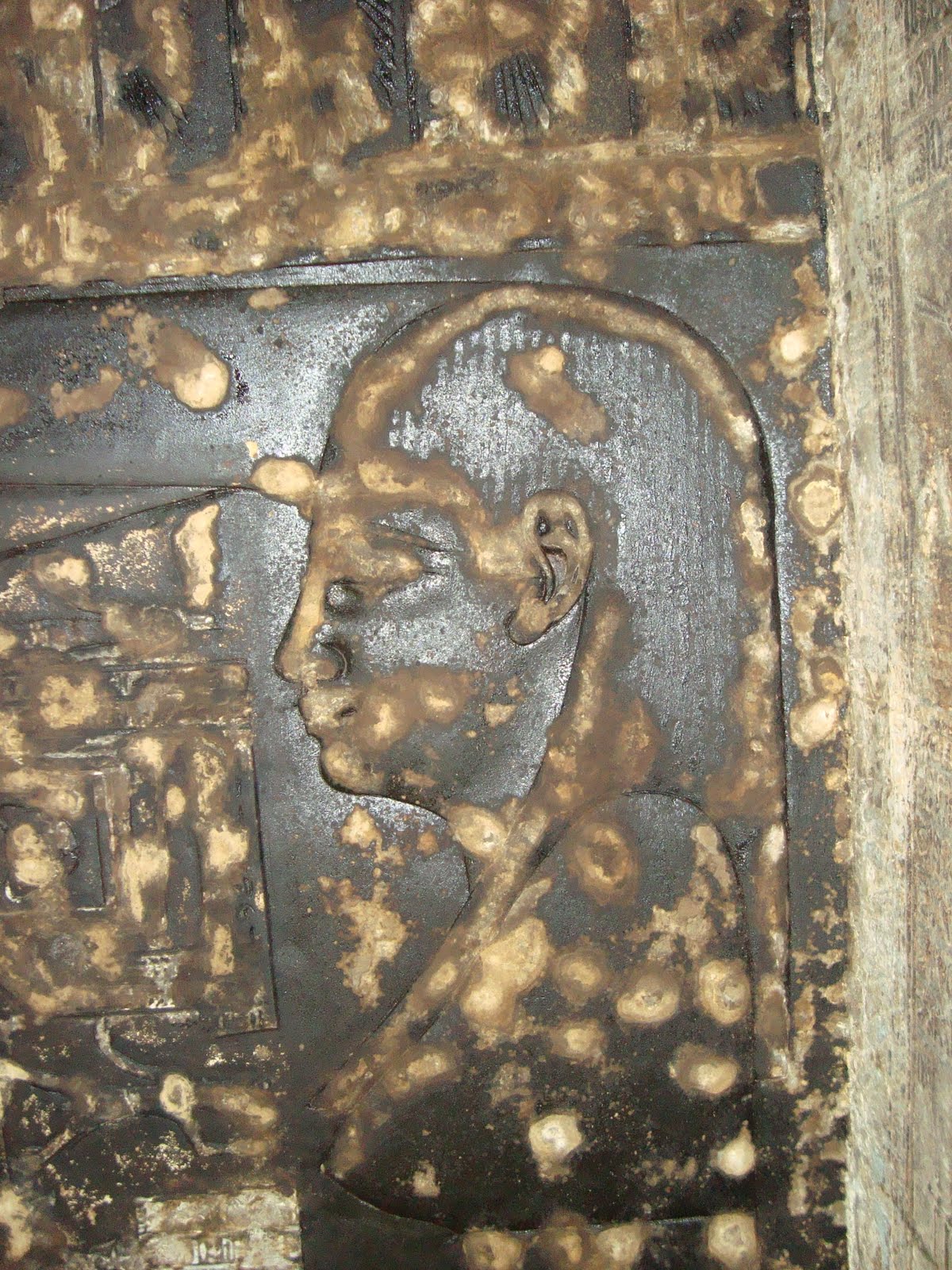
A beautiful Nut in Abydos.

With Isis outside the temple of Sethos I at Abydos.

I at one of Hathor's chapels in Dendera.

The Gang.

Back out in the sunlight.
In my last week I go back to the Theban Mountains on my own and spend a very happy day there exploring. I walk into Saff tombs and into other tombs, crouching down and crawling in through openings. I find bones and mummy wrappings, and bones with bitumen und resin and stuff on it, and cones. Nothing is worth anything, but I still leave everything in place. I'm a bit disappointed because I don't know whose tombs they are or which archaeological mission has the concession of them, but there's nothing I can do. I watch the sun set in Deir el-Bahari and say goodbye to Hatshepset. I'm very tired that evening, covered in dust and my shoes are beyond cleaning, but they weren't meant to come back home to Germany with me in the first place, and I am very happy. It was a great day in the Theban Mountains. As much as Luxor and modern day Egypt annoys me, as much do I love the Western Mountain and the timelessness there.

A ghafir at the mortuary temple of Sethos I in Dra' Abu el Naga pushed me up the ruins. I managed to tell him that I'm scared of heights in arabic!!! He wanted us to climb up even further, but I had enough.

Looking into one of the tombs.
I am told that there is going to be an exam on my last day in school and it amuses me, since I am doing the course just for fun and don't need the exam for anything. I study and at the same time I send out applications for jobs and prepare for interviews, which I hope to have when I'm back home. Sallam thinks I will have 100 per cent in my exam and I do, and I feel like I'm Hermione Granger. I hope I will manage to fit continuing to study Arabic into my busy schedule back home.
While I enjoy my last days in Luxor and count down the days to go home I hear about the uprising in Tunisia and the reactions in Cairo and Suez. I get emails from friends and family back home, asking me to be careful. I can see no reactions in Luxor, everything is as quiet and calm as always.
Of course I spend my last evening on the roof watching the sun set above the Theban Mountains, and the temple standing there, as grand and as silent as always.
I can't wait to come home to my lovely man.
Sunday, February 6, 2011
Cultural differences, studying and a day off in he Theban Mountains
One day during the teabreak I fix myself a cuppa and somehow manage to bang my head against the bookshelf in the corner. It isn't too bad. When the lesson ends and I leave the classroom the lovely Eugenia sits at the manager's desk holding a cold waterbottle against her face, cooling her eye. It turns out, she banged her head against the same bookshelf. While I only have a small lump on my forehead for a few days, Eugenia's eye turns dark purple and blank. We walk to the cash point together and the moment we leave school, a young Egyptian man materializes and starts: 'Hello. How arrrrrre you. What happened to your face?' 'I hit somebody who hussled me in the street', Eugenia answers, but sadly he doesn't believe us.
A few days later I lose my temper and raise my voice, telling a man in the street not to call me Sweety or Honey, that I am not his darling. He thinks I need to relax. I explain to him that he is being rude, but I leave it there, because they just don't get it and I'm just wasting my time.
The food at Affaf's is as good as it was at her sister's. The one thing I don't understand is that in the bathroom, there is neither any loo paper nor a suspicious looking tube. Yet I hear the family use the bathroom. I decide not to ponder too long on this. Since I have paid a lot of money to stay with a family I think they should provide loo paper, but I'm tired of asking for things. So I nick a role of loo paper from the school. I have my own loo paper now, and I'm not going to share it. The family can … do whatever they do in the bathroom.
Affaf has two very lovely daughters. The older one, Abla, speaks English very well. The younger one, Abia doesn't, but we still get by with smiles and single english and arabic words. She also wears a pyjama all day, and Affaf puts a nightgown on, when she gets in, even if she has to go out again a few hours later. Abia doesn't even get changed when she goes out to get some bread. Now I notice that all the little girls in the streets run around in their pyjamas all day. I ask Affaf, why they bother with long hair at all if they wrap themselves up all day. She explains to me that the women want to be beautiful for their husbands. „The most important person to like your hair is your husband“, she says. I disagree. I think the most important person to like her hair is she herself. But I realise I have given up on exchanging opinions.

Affaf and Abia
Sallam asks me, at what age women in Germany get pregnant, and why they don't have babies immediately after their wedding. I tell him women want to work. He doesn't understand that. He tells me so.'Why?', he asks. 'Because they enjoy it', I answer, 'they can chose what they want to work, who they want to marry, when they want to marry and when they want to have babies. They have choices.' He is convinced that women in Germany don't want to get married and don't want a family. 'That's not what I said', I answer, 'they do. Only they want other things as well. They want more.' 'That is very bad', Sallam says, 'I hope women here never think like that'. Of course you do, I think, but like so many times I stay silent. I wonder if he considers me a potential hazard now, who could wonder off and start putting dangerous ideas into their women's minds any time. I allow myself an evil smile by myself, but I know that I wouldn't achieve anything, even if I did want to put ideas into women's minds here. They think along the same lines like the men.
Many times I get annoyed. In this blog I don't write about the attitude of the Egyptian men and about how rude they are towards European women anymore, about the many run-ins I have with Sallam or about how it upsets me how Europeans are systematically being being ripped off, because I fear that this would turn into a very negative blog. My Arabic lessons become more and more demanding. I feel like a vessel that Sallam piles loads and loads of stuff into and even though I feel I'm full to the brim and can't take on any more, he still keeps pushing in more. I spend the afternoons with the Italian girls studying. We take the ferry to the westbank to sit in a garden café or we sit on the roof. It is very noisy up there and the smell of the Shisha that everybody around us seems to be smoking is not great. But the food and drinks are lovely and the view is so worth it, especially when the sunset paints the sky above the Theban Mountains pink. I love those mountains. The next Friday I take the Italian students onto a walk along the Western Mountains to help them make a connection to the land. We take the path up from Deir el-Medina and then along the ridge above the the tombs of the Nobles, take a peep into the Valley of the Kings and then come down around Hatshepsut's temple in Deir el-Bahari. It's good to spend a day in the sun, feeling the warmth and the dust on my skin and link in with Hatshepsut. I feel a strange connection to Hatshepsut, in a sort of female line/ancestorial way, and always have. I love her for her strength and her uniqueness, for her divineness, the daughter of Amun, who ruled as Pharao, and for her humanity, the woman who loved her country and her consort, Senmut. I love her temple and am very touched everytime I pass it.
I draw the attention of my friends to the beauty of the Theban Mountains, to all the tombs and to the fossilized shells from such a very long time ago, back when desert was an ocean. The immensity of the planet we live on, of life and of time makes me feel very much alive and connected to the whole world.

Paolo, Eugenia, I and Elisabeta


I at Deir el-Bahari, Hatshepsut's temple at the back

Moni and I at the restaurant after our landscape walk
A few days later I lose my temper and raise my voice, telling a man in the street not to call me Sweety or Honey, that I am not his darling. He thinks I need to relax. I explain to him that he is being rude, but I leave it there, because they just don't get it and I'm just wasting my time.
The food at Affaf's is as good as it was at her sister's. The one thing I don't understand is that in the bathroom, there is neither any loo paper nor a suspicious looking tube. Yet I hear the family use the bathroom. I decide not to ponder too long on this. Since I have paid a lot of money to stay with a family I think they should provide loo paper, but I'm tired of asking for things. So I nick a role of loo paper from the school. I have my own loo paper now, and I'm not going to share it. The family can … do whatever they do in the bathroom.
Affaf has two very lovely daughters. The older one, Abla, speaks English very well. The younger one, Abia doesn't, but we still get by with smiles and single english and arabic words. She also wears a pyjama all day, and Affaf puts a nightgown on, when she gets in, even if she has to go out again a few hours later. Abia doesn't even get changed when she goes out to get some bread. Now I notice that all the little girls in the streets run around in their pyjamas all day. I ask Affaf, why they bother with long hair at all if they wrap themselves up all day. She explains to me that the women want to be beautiful for their husbands. „The most important person to like your hair is your husband“, she says. I disagree. I think the most important person to like her hair is she herself. But I realise I have given up on exchanging opinions.

Affaf and Abia
Sallam asks me, at what age women in Germany get pregnant, and why they don't have babies immediately after their wedding. I tell him women want to work. He doesn't understand that. He tells me so.'Why?', he asks. 'Because they enjoy it', I answer, 'they can chose what they want to work, who they want to marry, when they want to marry and when they want to have babies. They have choices.' He is convinced that women in Germany don't want to get married and don't want a family. 'That's not what I said', I answer, 'they do. Only they want other things as well. They want more.' 'That is very bad', Sallam says, 'I hope women here never think like that'. Of course you do, I think, but like so many times I stay silent. I wonder if he considers me a potential hazard now, who could wonder off and start putting dangerous ideas into their women's minds any time. I allow myself an evil smile by myself, but I know that I wouldn't achieve anything, even if I did want to put ideas into women's minds here. They think along the same lines like the men.
Many times I get annoyed. In this blog I don't write about the attitude of the Egyptian men and about how rude they are towards European women anymore, about the many run-ins I have with Sallam or about how it upsets me how Europeans are systematically being being ripped off, because I fear that this would turn into a very negative blog. My Arabic lessons become more and more demanding. I feel like a vessel that Sallam piles loads and loads of stuff into and even though I feel I'm full to the brim and can't take on any more, he still keeps pushing in more. I spend the afternoons with the Italian girls studying. We take the ferry to the westbank to sit in a garden café or we sit on the roof. It is very noisy up there and the smell of the Shisha that everybody around us seems to be smoking is not great. But the food and drinks are lovely and the view is so worth it, especially when the sunset paints the sky above the Theban Mountains pink. I love those mountains. The next Friday I take the Italian students onto a walk along the Western Mountains to help them make a connection to the land. We take the path up from Deir el-Medina and then along the ridge above the the tombs of the Nobles, take a peep into the Valley of the Kings and then come down around Hatshepsut's temple in Deir el-Bahari. It's good to spend a day in the sun, feeling the warmth and the dust on my skin and link in with Hatshepsut. I feel a strange connection to Hatshepsut, in a sort of female line/ancestorial way, and always have. I love her for her strength and her uniqueness, for her divineness, the daughter of Amun, who ruled as Pharao, and for her humanity, the woman who loved her country and her consort, Senmut. I love her temple and am very touched everytime I pass it.
I draw the attention of my friends to the beauty of the Theban Mountains, to all the tombs and to the fossilized shells from such a very long time ago, back when desert was an ocean. The immensity of the planet we live on, of life and of time makes me feel very much alive and connected to the whole world.

Paolo, Eugenia, I and Elisabeta
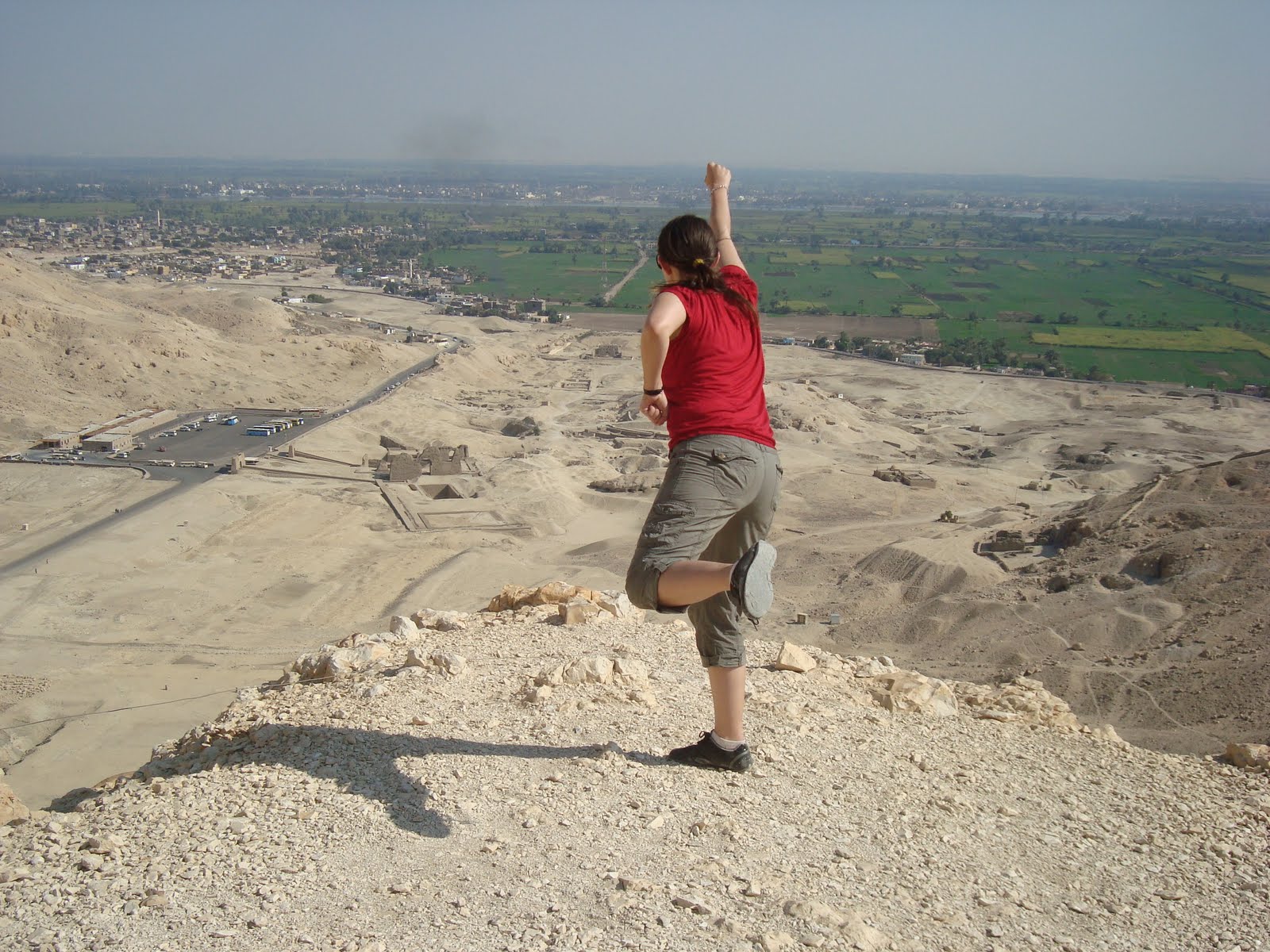

I at Deir el-Bahari, Hatshepsut's temple at the back

Moni and I at the restaurant after our landscape walk
Wednesday, January 26, 2011
Rain
One afternoon as I walk to school I feel something wet hit my face. I think I might be walking underneath somebody's balcony where they've put their washing out, but as I look up and check there is no balcony above me. All over town I ocasionally feel wet driplets on my face. There s nothing to be seen on the ground and I think, aha, so this is what you'd call rain in Egypt. In Germany I wouldn't even have noticed, but here it stands out, I think.
About one hour later I step onto the school's balcony. It is actually heavily raining! There are puddles in the street and I watch one clever Egyptian take the opportunity and wash his motorbike.
When I walk home after my belly dance class, the rain has stopped. It is quite cold and the streets are unusually empty. The town has changed. I see a few men still sitting outside cofee shops smoking their Shishas, but the usual crowd of people who just hangs out in the streets is gone, and so are the sweets sellers, the caleches, the taxis and the beggars. I take my time walking home, thoroughly enjoying being able to stroll down the streets without being hussled. The temple is still illuminated and I suspect that in the rain they might not have bothered switching the lights off which they usually do around nine. Maybe the rain has confused them so much that they forgot what they normally would have done. I can't believe my luck and take some spectacular shots of the pylon reflected in the puddle. At least I think they're spectacular. The stupid idea of this coffee table book is stuck in my head and I curse myself for it, because that's always how it starts... you have one good idea and then you end up organising a Conference... I shouldn't have thought that... now I'm thinking, surely putting together a coffee table book about Luxor temple must be a lot easier than that was?

Luxor Temple after the rain
After one week I move house. I don't want to leave, because I like Mona, Sayid and Zahwa, and at the same time I'm glad to go. At Affaf's, which is where I am staying now, there is a proper bathroom and I have my own bedroom. Sallam gives me a lot of homework everyday and it was too hard to keep up with things at Mona's. I couldn't study properly there, sharing a room where people kept going and out. Also because the family never went to bed before three o'clock in the mornings I also didn't sleep very well. It is very quiet at Affaf's. I spend the whole day on my homework and I don't know if this is because I am so tired or if I am so tired because I am studying all day. The first two nights I go to bed at 9:30 and sleep until 7:30. I'm amazed that I do manage to memorize all these words (or 'mommerize' as Sallam pronounces it) They either all sound the same and only differ in one letter, or they are so foreign to me that they are some meaningless syllables strung together and I go to lengths to find a suitable memory hook to remember them. But somehow my brain manages. I marvel at how my brain works, as if it wasn't part of me but something working on it's own accord, I have no idea how it does it, but I am thrilled that it does.

The Valley of the Queens
On Friday I rent a bike and cycle to the Valley of the Queens. It is a lovely warm sunny day and I am glad to be on my own. There are three tombs to be visited, two princes' and one queen's tomb, all 19th and 20th dynasty. The valley seems deserted, there are practically no visitors there and I take my time looking at the decorations. I am most interested in the depictions of the gods and goddesses. I see Sobek, Bastet, Thot, Osiris, Isis, Maat... and I have them all to myself. I am also getting really good at secretely taking photos. It's not allowed to take photos, but my conservator friend explained to me that there is no reason for this. The flash doesn't actually damage the decorations at all. I can't help myself though but think that the depictions of the goddesses are not as aesthetical and perfect as the ones of the 18th dynasty anymore. The proportions already start to look less graceful. I think that might be the heritage of the Armana style, when Akhenaton started to depict himself and his family a lot more natural then the pharaohs before him did. Or maybe this isn't my own clever conclusion, maybe I read that somewhere I can't remember. Anyway I think that the art of the ancient Egyptians had its peak in the 18th dynasty. Just look at the tombs of Ramose and Sennefer and at Hatshepsut's mortuary temple!


About one hour later I step onto the school's balcony. It is actually heavily raining! There are puddles in the street and I watch one clever Egyptian take the opportunity and wash his motorbike.
When I walk home after my belly dance class, the rain has stopped. It is quite cold and the streets are unusually empty. The town has changed. I see a few men still sitting outside cofee shops smoking their Shishas, but the usual crowd of people who just hangs out in the streets is gone, and so are the sweets sellers, the caleches, the taxis and the beggars. I take my time walking home, thoroughly enjoying being able to stroll down the streets without being hussled. The temple is still illuminated and I suspect that in the rain they might not have bothered switching the lights off which they usually do around nine. Maybe the rain has confused them so much that they forgot what they normally would have done. I can't believe my luck and take some spectacular shots of the pylon reflected in the puddle. At least I think they're spectacular. The stupid idea of this coffee table book is stuck in my head and I curse myself for it, because that's always how it starts... you have one good idea and then you end up organising a Conference... I shouldn't have thought that... now I'm thinking, surely putting together a coffee table book about Luxor temple must be a lot easier than that was?

Luxor Temple after the rain
After one week I move house. I don't want to leave, because I like Mona, Sayid and Zahwa, and at the same time I'm glad to go. At Affaf's, which is where I am staying now, there is a proper bathroom and I have my own bedroom. Sallam gives me a lot of homework everyday and it was too hard to keep up with things at Mona's. I couldn't study properly there, sharing a room where people kept going and out. Also because the family never went to bed before three o'clock in the mornings I also didn't sleep very well. It is very quiet at Affaf's. I spend the whole day on my homework and I don't know if this is because I am so tired or if I am so tired because I am studying all day. The first two nights I go to bed at 9:30 and sleep until 7:30. I'm amazed that I do manage to memorize all these words (or 'mommerize' as Sallam pronounces it) They either all sound the same and only differ in one letter, or they are so foreign to me that they are some meaningless syllables strung together and I go to lengths to find a suitable memory hook to remember them. But somehow my brain manages. I marvel at how my brain works, as if it wasn't part of me but something working on it's own accord, I have no idea how it does it, but I am thrilled that it does.

The Valley of the Queens
On Friday I rent a bike and cycle to the Valley of the Queens. It is a lovely warm sunny day and I am glad to be on my own. There are three tombs to be visited, two princes' and one queen's tomb, all 19th and 20th dynasty. The valley seems deserted, there are practically no visitors there and I take my time looking at the decorations. I am most interested in the depictions of the gods and goddesses. I see Sobek, Bastet, Thot, Osiris, Isis, Maat... and I have them all to myself. I am also getting really good at secretely taking photos. It's not allowed to take photos, but my conservator friend explained to me that there is no reason for this. The flash doesn't actually damage the decorations at all. I can't help myself though but think that the depictions of the goddesses are not as aesthetical and perfect as the ones of the 18th dynasty anymore. The proportions already start to look less graceful. I think that might be the heritage of the Armana style, when Akhenaton started to depict himself and his family a lot more natural then the pharaohs before him did. Or maybe this isn't my own clever conclusion, maybe I read that somewhere I can't remember. Anyway I think that the art of the ancient Egyptians had its peak in the 18th dynasty. Just look at the tombs of Ramose and Sennefer and at Hatshepsut's mortuary temple!


Thursday, January 20, 2011
Abu El-Haggag Mosque
One evening Affaf takes us to visit the Abu El-Haggag mosque. It is the oldest mosque in Luxor, and it sits right on top of the Amun temple. It was built when the ruins of the temple were covered by Nile mud. There is a catholic church close to the temple, run by Italian franciscan monks. When Eugenia, Paolo and I visited it, the monk told us that the first franciscan church was also built on the temple ruins, without them knowing that there was a great temple of Amun Re beneath it. When the temple was excavated the catholic church was moved to where it is now. The mosque was allowed to stay. Since I frankly just cannot be interested in everything in the world, I never bothered finding out much about Abu El-Haggag, but I do know that he is some sort of patron of Luxor. So the mosque is still there. The coptic church however will probably have to move anytime soon.

The altar of the Franciscan church

The altar of the Coptic church Santa Maria

Weird looking nativity set and dirty bikes in some corner in front of the Coptic church


The out side of the Coptic church
It is situated behind the temple above the sphynged alley. The great temple complex of Karnak is about three kilometres from the Amun temple in Luxor. In pharaonic times the two temples were connected by an avenue of sphynxes. A few of them have been restored and set up before the temples, with human heads in luxor and rams in Karnak. The rest of them lie under the town: In the course of millenia Nile mud, sand, dust and litter have accumulated above them and thus formed what is the ground level of modern day Luxor. One or two years ago however it was decided that the Sphynx alley was to be excarvated to make Luxor more attractive to tourists. So far I haven't met anybody who was happy about it. After all, there is a town above it and in the course of the excarvations, everything that's built on the course of the Avenue ist simply being torn down, including houses, mosques and churches. And my archaeologist friends told me the excarvations aren't even conducted properly, but without the necessary documentations. Aparently, since they know where the avenue is, they simply clear away all that's above it and litterally dig the sphynxes up. And since the coptic church is on that course, it seems likely that it will have to go, too. I don't know who's in charge of this excarvation, but since they have the power to remove buildings, I guess it's the egyptian government. The lady giving us the tour was very upset about it. She kept saying „This building is 102 years old!“ I couldn't help thinking, „Well, that's 102 years against 4000... not a chance.“

The Sphynged Avenue leading up to the Amun Temple
When we come to the mosque, we have to cover our hair, so Affaf helps us wind our scarfs around our faces like the Arabian women. We all giggle and take photos. Later Affaf and her sister Mahida, who also teaches at the school, tell us how beautiful we look and again I smile, wondering by myself whether they think something along the lines of „Finally they are dressed decently“. Outside the mosque in a corner there is a group of maybe 30 men, singing. One of them is singing words on a tune, while the others rhythmically sing the name „Allah“ and clap their hands. Their eyes are closed and they sway from side to side. It sounds lovely and the men look blissed out. I wonder whether we could somehow work with that in the Goddess movement and start thinking about a song, which we could use for a sort of trancey experience like that. Meditiation through song, rhythm, movement... it works for me, to feel the divine in my body. I love it actually. We stay quite a while, sitting in a circle on the floor, watching them.
When Affaf takes us into the mosque we see the tomb of Abu El-Haggag. I am more interested in the bits of temple masonary that have been built into the mosque. I walk around and I see that the mosque actually sits on a much higher level than the temple, and I remember that Affaf told us it was built when the temple was hidden under Nile mud. In the men's prayer hall a fries of pharaos runs along the length of the wall, the women's prayer hall is built into the first court of papyrus pillars. I can actually touch the chapters and I love it. I love how the architecture of the new and the old blend into each other. I love seeing the cartouches of the pharaoh's names in this islamic house of prayer. I don't see many reliefs that have been chiselled out, and I wonder whether, if I could read hieroglyphs, I could find the name of Amun somewhere in the mosque. Or Isis even?
I like the mosque a lot. All the pharaoh's added to the temple in praise of Amun and at the same time securing their own immortality. To me the mosque is just like that. Amun and Allah are but different names for the one Source and Abu Al- Haggag added to the temple complex, ensuring his own memento in the process, just like Amenophis III, Hatschepsut, Tuthmosis III and all the others.
I'm having an utterly lovely time in the mosque. I take some photos of the pillars and the giant statues, only now my perspective standing by the mosque is that I'm looking down to them. It's fantastic. More photos of Luxor temple for my coffee book table.
When we leave the mosque the girls and I start a little experiment. We keep the scarfs on as we walk back to the school to see if we're still being hussled as much. There is singing and drumming in front of a photo studio and Affaf explains to us that it's a wedding, and the couple is having their picture taken inside. We stop and watch a little and suddenly four young girls come up to us, smiling. They want to talk to us, which has never happened before, the girls have never approached us before. They want to know our names and whether we're muslimas. I'm fascinated of how easy it is to set up a barrier between women, but also how easy it is to build a bridge. When we tell them that we're not they seem a bit disappointed, but still interested. They don't speak english though and my arabic is not yet fit for a conservation. So I give them a smile and wave at a taxi. I go home.

Monika, Elisabetta, Sophia, Alice and I

Top of one pillar of the temple integrated into the architecture of the mosque

View from the mosque down into the temple court

The altar of the Franciscan church

The altar of the Coptic church Santa Maria

Weird looking nativity set and dirty bikes in some corner in front of the Coptic church


The out side of the Coptic church
It is situated behind the temple above the sphynged alley. The great temple complex of Karnak is about three kilometres from the Amun temple in Luxor. In pharaonic times the two temples were connected by an avenue of sphynxes. A few of them have been restored and set up before the temples, with human heads in luxor and rams in Karnak. The rest of them lie under the town: In the course of millenia Nile mud, sand, dust and litter have accumulated above them and thus formed what is the ground level of modern day Luxor. One or two years ago however it was decided that the Sphynx alley was to be excarvated to make Luxor more attractive to tourists. So far I haven't met anybody who was happy about it. After all, there is a town above it and in the course of the excarvations, everything that's built on the course of the Avenue ist simply being torn down, including houses, mosques and churches. And my archaeologist friends told me the excarvations aren't even conducted properly, but without the necessary documentations. Aparently, since they know where the avenue is, they simply clear away all that's above it and litterally dig the sphynxes up. And since the coptic church is on that course, it seems likely that it will have to go, too. I don't know who's in charge of this excarvation, but since they have the power to remove buildings, I guess it's the egyptian government. The lady giving us the tour was very upset about it. She kept saying „This building is 102 years old!“ I couldn't help thinking, „Well, that's 102 years against 4000... not a chance.“

The Sphynged Avenue leading up to the Amun Temple
When we come to the mosque, we have to cover our hair, so Affaf helps us wind our scarfs around our faces like the Arabian women. We all giggle and take photos. Later Affaf and her sister Mahida, who also teaches at the school, tell us how beautiful we look and again I smile, wondering by myself whether they think something along the lines of „Finally they are dressed decently“. Outside the mosque in a corner there is a group of maybe 30 men, singing. One of them is singing words on a tune, while the others rhythmically sing the name „Allah“ and clap their hands. Their eyes are closed and they sway from side to side. It sounds lovely and the men look blissed out. I wonder whether we could somehow work with that in the Goddess movement and start thinking about a song, which we could use for a sort of trancey experience like that. Meditiation through song, rhythm, movement... it works for me, to feel the divine in my body. I love it actually. We stay quite a while, sitting in a circle on the floor, watching them.
When Affaf takes us into the mosque we see the tomb of Abu El-Haggag. I am more interested in the bits of temple masonary that have been built into the mosque. I walk around and I see that the mosque actually sits on a much higher level than the temple, and I remember that Affaf told us it was built when the temple was hidden under Nile mud. In the men's prayer hall a fries of pharaos runs along the length of the wall, the women's prayer hall is built into the first court of papyrus pillars. I can actually touch the chapters and I love it. I love how the architecture of the new and the old blend into each other. I love seeing the cartouches of the pharaoh's names in this islamic house of prayer. I don't see many reliefs that have been chiselled out, and I wonder whether, if I could read hieroglyphs, I could find the name of Amun somewhere in the mosque. Or Isis even?
I like the mosque a lot. All the pharaoh's added to the temple in praise of Amun and at the same time securing their own immortality. To me the mosque is just like that. Amun and Allah are but different names for the one Source and Abu Al- Haggag added to the temple complex, ensuring his own memento in the process, just like Amenophis III, Hatschepsut, Tuthmosis III and all the others.
I'm having an utterly lovely time in the mosque. I take some photos of the pillars and the giant statues, only now my perspective standing by the mosque is that I'm looking down to them. It's fantastic. More photos of Luxor temple for my coffee book table.
When we leave the mosque the girls and I start a little experiment. We keep the scarfs on as we walk back to the school to see if we're still being hussled as much. There is singing and drumming in front of a photo studio and Affaf explains to us that it's a wedding, and the couple is having their picture taken inside. We stop and watch a little and suddenly four young girls come up to us, smiling. They want to talk to us, which has never happened before, the girls have never approached us before. They want to know our names and whether we're muslimas. I'm fascinated of how easy it is to set up a barrier between women, but also how easy it is to build a bridge. When we tell them that we're not they seem a bit disappointed, but still interested. They don't speak english though and my arabic is not yet fit for a conservation. So I give them a smile and wave at a taxi. I go home.
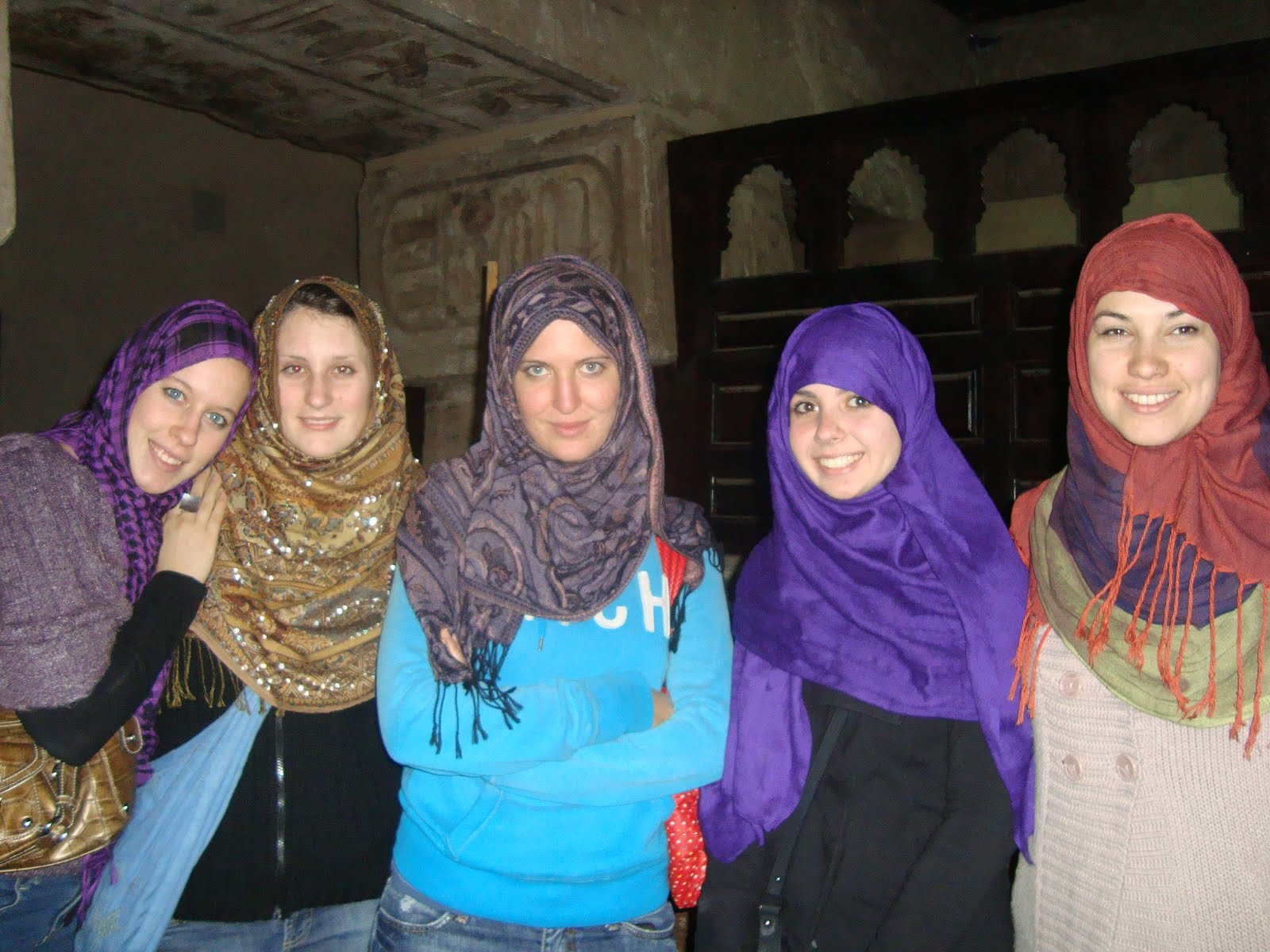
Monika, Elisabetta, Sophia, Alice and I

Top of one pillar of the temple integrated into the architecture of the mosque

View from the mosque down into the temple court
Subscribe to:
Posts (Atom)